The University of Waterloo is home to the largest engineering school in Canada. Founded in 1957 to train skilled engineers for local industries, the institution has been central to the Waterloo Region’s economic growth. Its students, researchers and alumni have helped forge the Toronto-Waterloo tech corridor — known as the “Silicon Valley of the North” — and put the University on the global map.
Waterloo’s reputation is underscored by its internationally renowned co-op program and entrepreneurial ethos. Its global co-op employer network of more than 8,000 organizations in 70 countries — from Fortune 500 leaders to tech startups — hire Waterloo talent. These students develop real-world skills and insights while studying, putting them ahead of their peers to secure meaningful employment after graduation or to start their own businesses. Alumni from the Faculty of Engineering alone have launched more than 1,000 startups.
Christopher Nielsen, P.Eng. is a professor of electrical and computer engineering and the associate dean, graduate studies and postdoctoral affairs in the Faculty of Engineering at the University of Waterloo. He spoke with NEM Ontario about Waterloo’s unique experiential learning experience and what makes its students so special. Here are excerpts from that conversation, edited for length and clarity.

Christopher Nielsen, P.Eng., Professor of Electrical and Computer Engineering and Associate Dean, Graduate Studies and Postdoctoral Affairs at the University of Waterloo.
Waterloo has an amazing reputation. What do you think makes the University so special?
It really comes down to our origin story. In 1957, about 75 students founded this engineering school — working in small classrooms, then heading straight into industry. That combination of classroom and workplace experience is in the University’s DNA.
Our students make real impact during co-op, then bring that experience back to the classroom. That cycle of work and study has created an environment that attracts exceptional students and faculty. The alternating model is widely imitated these days, but the quality and maturity of Waterloo’s co-op program has never been duplicated.
How does the University of Waterloo’s co-op program shape its students?
Students alternate between four-month study terms and four-month work terms over four years and graduate with two full years of work experience. Two things stand out in how that changes them.
Maturity. When students return from work terms, the growth is immediate and visible. They come in as strong academics, but co-op adds professionalism — punctuality, workplace relationships, interpersonal skills. Many also live away from home for the first time, which brings its own learning curve: finding housing, managing day-to-day life. They come back noticeably more grounded.
Renewed motivation. On the job, students see senior engineers doing work they want to do someday. That’s a powerful motivator when they return to the classroom — they now have a clear goal to aim for. They also see firsthand that real engineering projects don’t stay neatly inside one discipline. That builds genuine appreciation for other fields and a sense of belonging to something bigger than their own program.
More than 1,000 startups have come out of the University of Waterloo. What fosters that entrepreneurial spirit?
A few things work together. Our intellectual property policy is a big one — unlike most universities, if you develop an idea or commercialize something at Waterloo, you own it. The University doesn’t take a cut. That’s a meaningful signal: what you make is yours.
Then there’s the infrastructure. The Conrad School of Entrepreneurship and Business — Canada’s leading entrepreneurship school — sits within the Faculty of Engineering. That proximity creates real synergy for students who want to turn an idea into something. Velocity, the University’s startup incubator, supports near-graduated and recently graduated student startups with incubation space and investor connections.
And there’s a cultural dimension too. When students go on co-op and see Waterloo-linked startups in their job listings, it becomes concrete: I could do that. All these pieces reinforce each other to build a genuine culture of entrepreneurship.
What is it like to be a student at Waterloo?
There’s a perception that Waterloo is all projects and co-op placements with nothing else. That’s not accurate.
Take the Iron Ring Ceremony. Every year, in the week of the ceremony, students pull off creative stunts and pranks. This year, they installed a full-sized catamaran — not a small sailboat, a catamaran — on the ground floor of an engineering building. That kind of thing doesn’t happen without a tight-knit community of trained problem-solvers behind it.
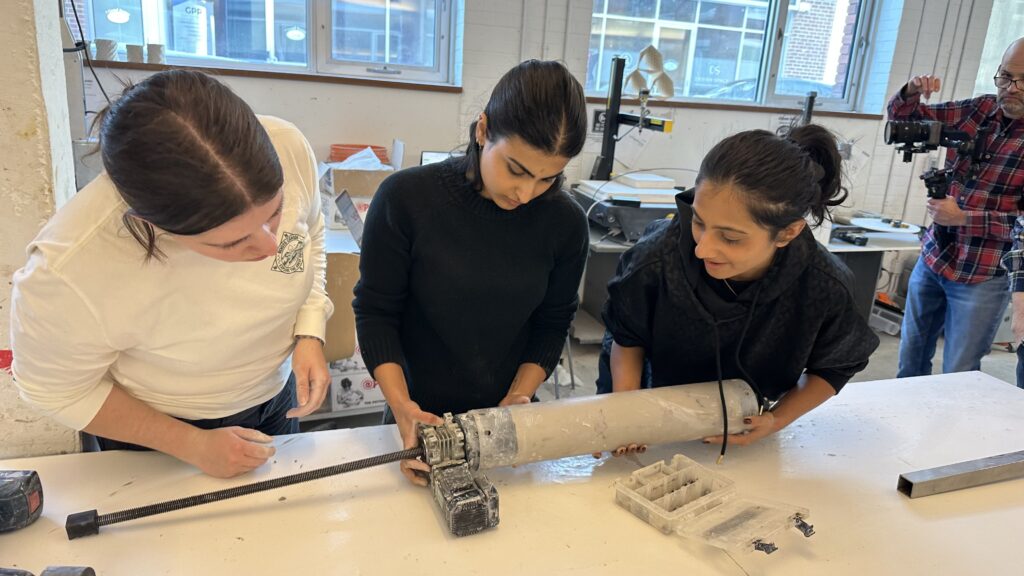
In engineering, you’re with largely the same cohort for five years. You build real friendships, and that camaraderie makes the hard academic stretches more manageable. Beyond that, Waterloo has clubs, athletics, student teams launching rockets and building electric vehicles — with dedicated spaces, funding support and staff to help them navigate everything from tool access to international competition visas.
The culture is also genuinely collaborative, not competitive. Students aren’t trying to outdo each other for grades — they’re helping each other get there.
And Dean Mary Wells sets the tone. She makes a point of being accessible — every other Thursday, you’ll find her downstairs having coffee with students.
What excites you about the future at Waterloo?
There’s a major focus right now on health — something that touches everyone and a core component of the University’s global futures vision for Waterloo at 100. A new hospital is being built on campus, in close partnership with the Waterloo Region Health Network. It’s the first new hospital in the region in roughly 50 years, and the people behind it are working intentionally with the University to make it a genuine hub for health technology. That’s going to make it significant for health technology research.
But honestly, the most exciting part is the students themselves. Ambitious, creative, driven — they’re the heartbeat of this place. You never quite know what they’re going to come up with next, and that’s exactly what makes the future worth watching.